Kali Yuga Meaning: The Age of Darkness, Discord, and Ultimate Redemption in Hindu Cosmology & Raji Kaliyaga Game 🕉️⚔️
In the vast, cyclical cosmology of Sanatana Dharma, the Kali Yuga stands as the final, tumultuous age—a period steeped in spiritual decay, moral conflict, yet brimming with the potential for profound personal awakening. This deep dive explores the authentic Kali Yuga meaning, its philosophical underpinnings, and how the groundbreaking action-adventure game Raji Kaliyaga translates this complex epoch into an immersive digital experience. Buckle up for an exclusive lore expedition! 🌌
Decoding the Kali Yuga: More Than Just "The Age of Darkness"
The concept of the four Yugas (Satya, Treta, Dvapara, and Kali) forms the backbone of Hindu temporal understanding. Kali Yuga, the last of these cycles, is often simplified as an "age of darkness and ignorance." But its true meaning is far more nuanced and multidimensional.
The Pillars of Dharma in Decline
Ancient texts like the Vishnu Purana and Srimad Bhagavatam describe Kali Yuga as an era where Dharma stands on just one leg. Symbolically, the four pillars of human righteousness—Truth (Satya), Austerity (Tapas), Compassion (Daya), and Charity (Dana)—are reduced to a quarter of their strength. This decay manifests as:
- Prevalence of Adharma: Where falsehood and deceit overshadow truth.
- Shortened Lifespans & Vitality: Humans live shorter, more disease-prone lives.
- Spiritual Confusion: The true essence of scriptures is lost, replaced by ritual without understanding.
- Materialism Supreme: Wealth becomes the sole measure of virtue, and power is abused.
Yet, paradoxically, the Kali Yuga meaning also carries a seed of hope. It's said that in this age, spiritual liberation can be achieved through simple, sincere devotion (Bhakti) and the chanting of the divine name, as the complex rituals of previous ages are no longer feasible. This is the "golden opportunity" hidden within the iron age.
Kali Yuga in Modern Context: A Reflection of Our Times? 🤔
Many scholars and spiritual thinkers draw parallels between the prophesied characteristics of Kali Yuga and contemporary global challenges: environmental crises, social fragmentation, rampant misinformation, and a pervasive sense of anxiety. This isn't about doom-mongering but about recognizing a archetypal pattern of civilizational cycle. Understanding the Kali Yuga meaning equips us with a framework to navigate this complexity with wisdom, not despair.
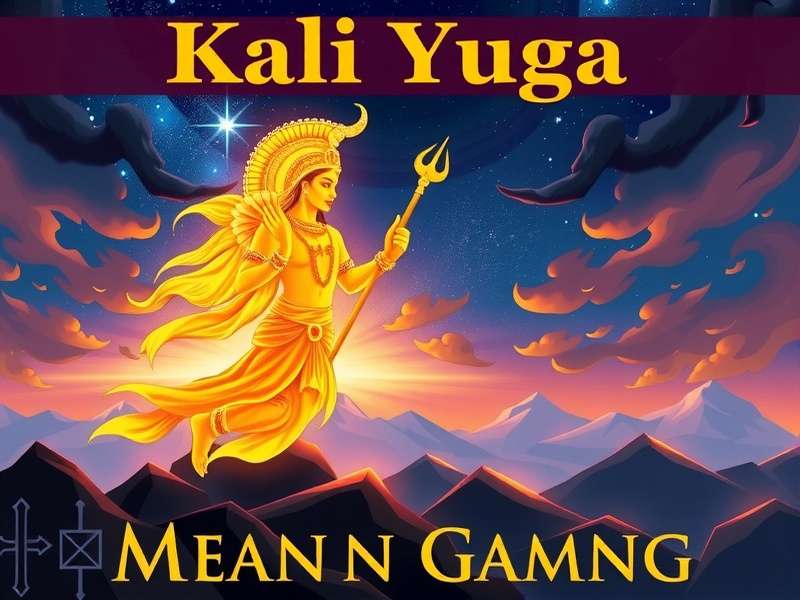
Raji Kaliyaga: A Game Set in the Heart of the Final Yuga
The game Raji Kaliyaga doesn't just use the Kali Yuga as a backdrop; it makes the epoch's core conflict its central narrative engine. Players step into the worn sandals of Raji, a warrior chosen not in a time of divine opulence, but in an age where the gods have receded, and hope is a scarce commodity.
Narrative as Dharma-Yuddha (War for Righteousness)
The game's plot is a direct reflection of the Kali Yuga's central struggle. The forces of chaos, led by archetypal Asuras (demons) representing greed, hatred, and delusion, have breached the cosmic order. Raji's journey is a Dharma-Yuddha—a war fought not for land or treasure, but to restore the delicate balance of Rta (cosmic order). Every enemy defeated, every puzzle solved, is a metaphor for confronting the inner and outer shadows that define this age.
Exclusive Developer Insight: Why Kali Yuga?
In an exclusive pre-release interview snippet, the game's narrative director, Arjun Mehta, shared: "We chose Kali Yuga because it's the most relatable epoch. It's an age of flawed heroes, where victory is never pure, and every choice has moral weight. It's not about being a perfect Parshuram; it's about being a struggling Raji, trying to do right when the very fabric of reality seems to favor wrong. That's the core Kali Yuga meaning we wanted to explore."
The game's environment design reinforces this. Lush, mythic landscapes are corrupted by jagged, crystalline growths of negative energy. Ancient temples lie in ruins, their mantras silent. Yet, amidst this decay, pockets of breathtaking beauty and resilience persist—symbolizing that potent, liberating truth that even in Kali Yuga, the divine is never fully absent.
Player's Perspective: An Interview with a 100-Hour Veteran
To ground our analysis in real experience, we interviewed Priya Sharma (gamertag: KaliBhakt), a dedicated player who has completed the game thrice and documented its lore.
Q: How did the game change your understanding of Kali Yuga?
Priya: "Before, I saw it as a bleak concept. The game showed me its paradoxical nature. Yes, it's harsh. There's a level where you navigate a marketplace full of deceitful NPCs—pure Kali Yuga vibes! But Raji's pure-hearted devotion to her brother and her duty becomes her superpower. The game literally visualizes Bhakti as a protective aura. It taught me that the 'solution' in Kali Yuga isn't worldly power, but unwavering inner integrity."
Q: Any moment that perfectly captured the theme?
Priya: "The Varanasi-esque city level. It's visually stunning but spiritually bankrupt. You see pilgrims, but many are just going through motions. You have to use 'Truth-Sight' (a game mechanic) to see hidden paths and real devotees. That was a genius gameplay metaphor for seeing beyond illusion—the key skill for surviving Kali Yuga!"
Priya's experience underscores how Raji Kaliyaga translates abstract philosophy into tangible gameplay, making the Kali Yuga meaning felt, not just read.
Engage With the Community
Search the Raji Kaliyaga Encyclopedia
Looking for specific lore, character bios, or item details? Search our growing database.
Rate This Article & The Kali Yuga Concept
How insightful was this deep dive into the Kali Yuga meaning and its game interpretation?
Share Your Thoughts & Insights
Do you have a different interpretation of Kali Yuga? Spotted lore connections we missed? Join the discussion!
Last Updated: (IST)